Introduction
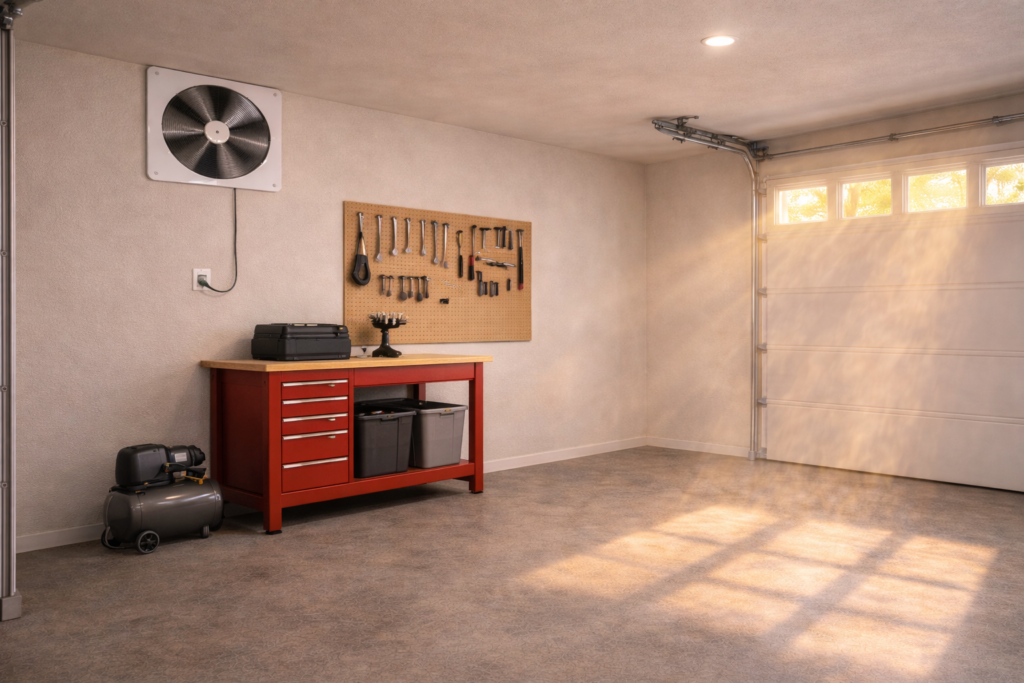
Installing a garage ventilation fan can improve airflow and help remove hot air from the space. However, some homeowners find that their garage still feels very hot even after installing a fan.
This usually happens because ventilation alone cannot solve every heat-related issue. Several factors influence how effectively a ventilation fan can reduce temperature.
Understanding these factors can help identify why the garage remains hot and what adjustments may improve airflow.
If you’re unfamiliar with how garage ventilation systems work, start with what a garage ventilation fan is and how it works.
Ventilation Fans Do Not Act Like Air Conditioners
A common misunderstanding is that ventilation fans cool air in the same way an air conditioner does.
Ventilation fans do not actively cool air. Instead, they remove hot air and replace it with outside air.
This means the temperature inside the garage will usually move closer to the outdoor temperature.
If the outside air is extremely hot, ventilation alone may not significantly lower the temperature inside the garage.
To understand this better, see do garage ventilation fans actually reduce heat.
The Fan May Be Too Small
One of the most common reasons a garage stays hot is that the fan does not move enough air.
If the airflow capacity is too low, the fan may struggle to remove heat quickly enough.
Ventilation fans are rated by airflow measured in cubic feet per minute (CFM).
If the fan is undersized for the garage, heat can continue to accumulate faster than the fan removes it.
If you’re evaluating airflow requirements, see how much airflow (CFM) a garage needs.
Choosing the correct fan size is important for effective ventilation.
Poor Fan Placement
The location of the fan can also affect how well it removes heat.
Hot air rises, which means the warmest air is usually near the ceiling.
If the fan is installed too low on the wall, it may not remove the hottest air from the garage.
Most ventilation fans work best when installed:
• High on an exterior wall
• Near the ceiling
• Where hot air collects
For placement guidance, see where a garage ventilation fan should be installed.
Correct placement can significantly improve airflow performance.
Lack of Fresh Air Intake
A ventilation fan removes air from the garage, but fresh air must enter to replace it.
If the garage does not have an adequate intake path, the fan may struggle to move air effectively.
Fresh air typically enters through:
• Gaps around the garage door
• Windows
• Passive intake vents
• Small wall openings
Without an intake source, airflow through the garage may remain weak.
Heat From the Roof and Garage Door
Garages often absorb large amounts of heat from sunlight.
Common sources of heat include:
• Sunlight heating the roof
• Sun exposure on the garage door
• Warm air entering when vehicles are parked
These heat sources can continue warming the garage even while the ventilation fan is running.
Long Duct Runs
If the fan vents through long ductwork, airflow may be reduced.
Long or complex duct runs can restrict airflow and reduce ventilation performance.
Short, direct vent paths usually work best.
If you are evaluating your venting setup, see how to vent a garage exhaust fan outside.
Improving the venting path can help restore airflow efficiency.
When Ventilation May Not Be Enough
In extremely hot climates, ventilation alone may not be enough to significantly lower garage temperatures.
In these cases, ventilation still provides benefits by:
• Removing trapped heat
• Improving air circulation
• Removing fumes and odors
However, additional cooling strategies may sometimes be required.
Conclusion
If a garage remains hot after installing a ventilation fan, the issue is often related to airflow capacity, fan placement, or limited intake air.
Ventilation fans remove heat by exhausting hot air and allowing fresh air to enter. For this process to work effectively, the fan must be properly sized, correctly positioned, and connected to a well-designed venting path.
Addressing these factors can help improve the overall performance of a garage ventilation system.
For a complete overview of how these systems work, see our guide to garage ventilation fans.