Introduction
The location of a garage ventilation fan plays a major role in how effectively it removes heat, fumes, and stale air. Even a powerful fan may struggle to improve airflow if it is installed in the wrong position.
In most garages, the goal is to remove the hottest and most contaminated air while allowing fresh air to enter from another location. Proper placement helps create a steady airflow path through the space.
If you’re new to garage ventilation systems, it may help to first understand what a garage ventilation fan is and how it works.
Install the Fan Near the Ceiling
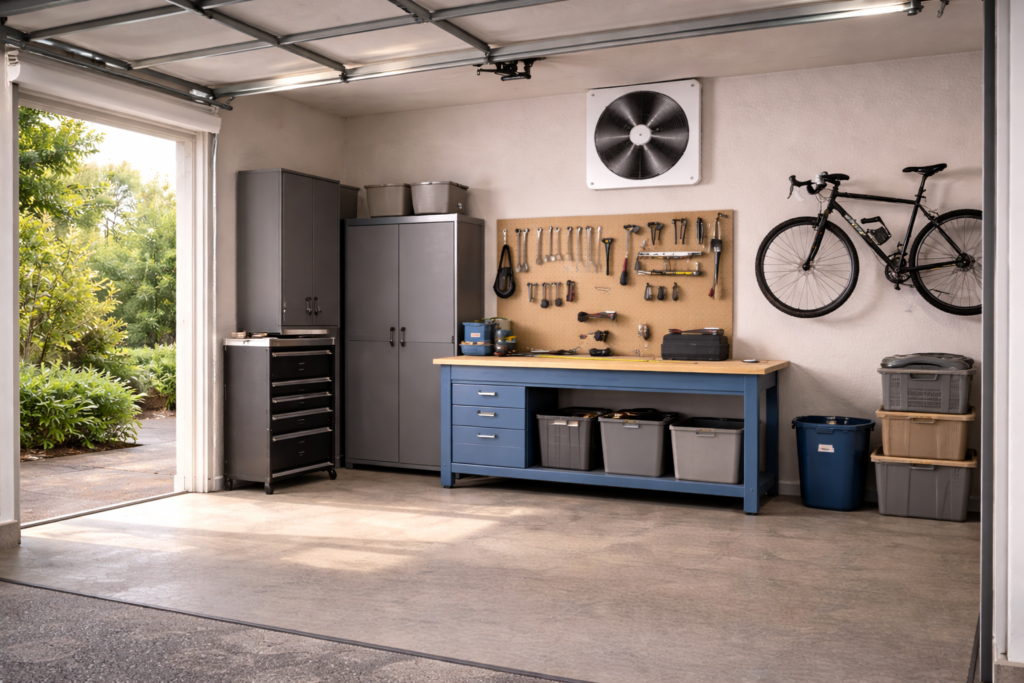
Hot air naturally rises, which means the warmest air in the garage usually collects near the ceiling.
For this reason, ventilation fans are typically installed:
• High on an exterior wall
• In the upper portion of the garage wall
• In the ceiling if wall placement is not possible
Installing the fan near the ceiling allows it to remove hot air where it accumulates the most.
Place the Fan on an Exterior Wall
The easiest and most effective installation location is usually an exterior wall.
A wall-mounted fan can exhaust air directly outside, which reduces airflow resistance and simplifies installation.
Exterior wall placement often provides:
• A shorter exhaust path
• Better airflow efficiency
• Simpler installation
To compare installation styles, see wall vs ceiling garage ventilation fans.
Allow Fresh Air to Enter the Garage
For ventilation to work properly, air must be able to enter the garage as the fan removes air.
Without an intake path, the fan will struggle to move air effectively.
Fresh air can enter through:
• Small gaps around the garage door
• Passive intake vents
• Windows
• Additional wall vents
The goal is to create a simple airflow path where fresh air enters the garage and stale air exits through the fan.
Avoid Obstructions Around the Fan
Ventilation fans work best when airflow is not blocked by objects inside the garage.
Avoid placing the fan near:
• Large storage cabinets
• Shelving units
• Overhead storage racks
• Tall equipment
Clear airflow around the fan allows it to remove air more efficiently.
Position the Fan Away From Intake Air
Ideally, the fan should be located across the garage from where fresh air enters.
This encourages air to move through the entire space instead of circulating only in a small area.
For example:
• Fresh air enters near the garage door
• The fan exhausts air near the back wall
This creates a more effective cross-ventilation pattern.
Consider Garage Size and Layout
The best fan location can also depend on the size and layout of the garage.
Larger garages may require:
• Higher airflow capacity
• Strategic placement to reach all areas of the space
If you are estimating airflow requirements, see how much airflow (CFM) a garage needs.
Choosing the correct fan size helps ensure the ventilation system works effectively.
Special Considerations for Attached Garages
Attached garages may require more careful placement because the garage shares walls with the home.
Ventilation fans are often installed on the exterior wall farthest from the house to help direct fumes away from living areas.
If your garage is attached to your home, see do you need ventilation in an attached garage.
Proper placement can help reduce the chance of fumes entering the home.
Ceiling Installation Considerations
If wall installation is not possible, a ceiling-mounted fan can still provide effective ventilation.
In these cases, the fan usually connects to ductwork that vents outside through the roof or an exterior wall.
Ceiling installations may be more complex but can still remove hot air effectively when properly vented.
Conclusion
Installing a garage ventilation fan in the correct location helps maximize airflow and improve ventilation performance.
In most garages, the best location is high on an exterior wall where hot air collects. The fan should also be positioned so that fresh air can enter the garage while stale air is exhausted outside.
Proper placement allows the ventilation system to remove heat, fumes, and stale air more effectively.
For a complete overview of how these systems work, see our guide to garage ventilation fans.