Introduction
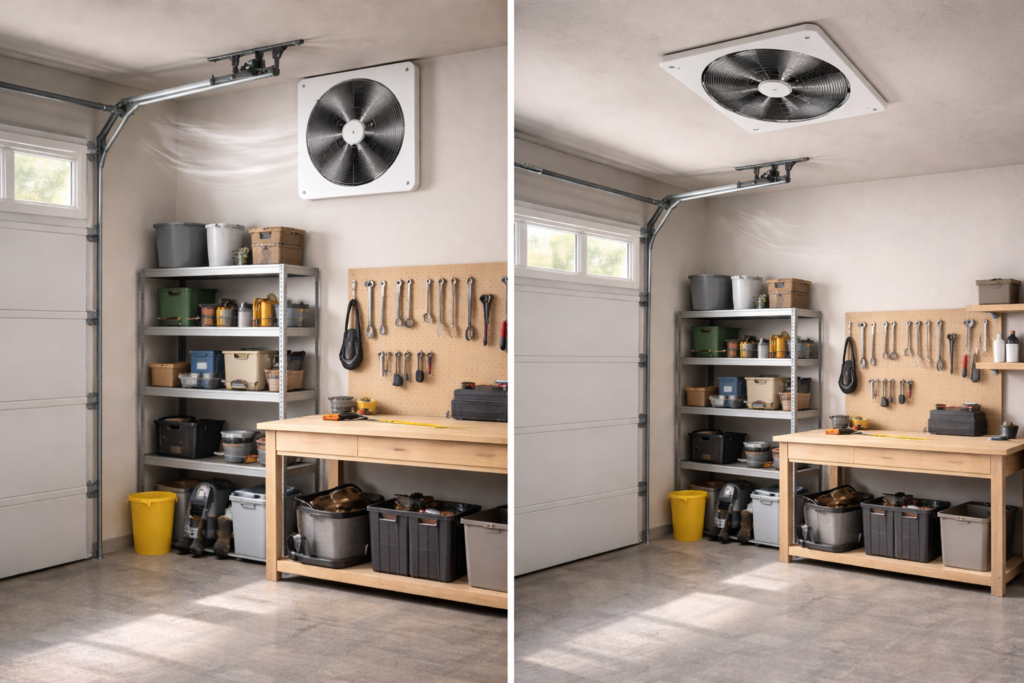
Garage ventilation fans are commonly installed in either the wall or the ceiling. Both types remove hot air, fumes, and stale air from the garage, but the installation method can affect airflow performance, installation complexity, and overall cost.
Choosing between a wall-mounted fan and a ceiling-mounted fan often depends on the garage layout, the location of exterior walls, and how easy it is to vent air outside.
If you’re new to garage ventilation systems, it may help to first understand what a garage ventilation fan is and how it works.
How Wall-Mounted Garage Ventilation Fans Work
Wall-mounted garage ventilation fans are installed directly into an exterior wall of the garage. The fan pulls air from inside the garage and exhausts it straight outdoors through the wall opening.
Because the air is vented directly outside, these systems are usually simple and efficient.
Common characteristics of wall-mounted fans include:
• Direct airflow to the exterior
• Short exhaust path
• Easier installation in many garages
• Lower installation cost in most cases
Wall-mounted fans are the most common solution in residential garages because they avoid the need for roof venting or long duct runs.
How Ceiling-Mounted Garage Ventilation Fans Work
Ceiling-mounted ventilation fans are installed in the ceiling of the garage and vent air through ductwork to an exterior wall or roof vent.
This design is similar to many bathroom exhaust fans but typically uses larger, more powerful fans to move more air.
Ceiling installations are often used when:
• There is no suitable exterior wall location
• The garage is located beneath living space
• The homeowner prefers hidden ventilation hardware
Because ceiling fans require ducting and roof or wall venting, the installation process is often more involved.
If you’re considering installing a fan yourself, see can you install a garage ventilation fan yourself.
Advantages of Wall-Mounted Garage Ventilation Fans
Wall-mounted fans offer several practical advantages.
Easier Installation
Installing a fan through an exterior wall is typically simpler than installing ductwork through a ceiling and roof.
Stronger Direct Airflow
Because air is exhausted directly outside, wall-mounted fans often move air more efficiently with less airflow resistance.
Lower Installation Cost
Shorter airflow paths and fewer materials often make wall installations more affordable.
If you’re estimating the cost of installing a fan, you can review garage ventilation fan installation costs.
Common in Residential Garages
Most residential garage ventilation systems use wall-mounted fans because they are practical and effective.
Advantages of Ceiling-Mounted Garage Ventilation Fans
Ceiling-mounted fans also offer several benefits in certain situations.
Better Placement for Rising Heat
Heat naturally rises toward the ceiling. A ceiling-mounted fan can remove hot air directly from the highest part of the garage.
Flexible Venting Options
Ceiling fans can vent through:
• Roof vents
• Wall vents
• Ductwork routing
This flexibility can be useful when exterior wall installation is not possible.
Less Visible Hardware
Because the fan is mounted in the ceiling, it may be less noticeable inside the garage.
Airflow Performance Considerations
The effectiveness of a ventilation fan depends not only on where it is installed but also on its airflow capacity.
Airflow is measured in cubic feet per minute (CFM), which indicates how much air the fan can move.
If you are trying to determine the airflow requirements for your garage, see how much airflow (CFM) a garage needs.
In most cases, the airflow rating of the fan has a greater impact on ventilation performance than the installation style.
Choosing the Right Location for the Fan
Whether the fan is installed in the wall or ceiling, proper placement is important.
Good ventilation usually requires:
• Installing the fan high on the wall or ceiling
• Allowing fresh air to enter from another location
• Avoiding airflow obstructions
You can learn more about optimal placement in where a garage ventilation fan should be installed.
Which Option Is Better?
In many residential garages, wall-mounted ventilation fans are the most practical choice. They are easier to install, require fewer materials, and provide a direct airflow path outside.
However, ceiling-mounted fans can work well when wall installation is not possible or when the design of the garage makes ceiling ventilation more effective.
The best option ultimately depends on:
• Garage layout
• Exterior wall access
• Roof or wall venting options
• Installation difficulty
• Personal preference
Conclusion
Both wall-mounted and ceiling-mounted garage ventilation fans can effectively remove heat, fumes, and stale air from a garage.
Wall-mounted fans are often easier and more affordable to install, while ceiling-mounted fans may provide more flexible placement and improved heat removal in certain situations.
Choosing the right option depends on your garage structure and how the ventilation system will be installed.
For a complete overview of how these systems work, see our guide to garage ventilation fans.